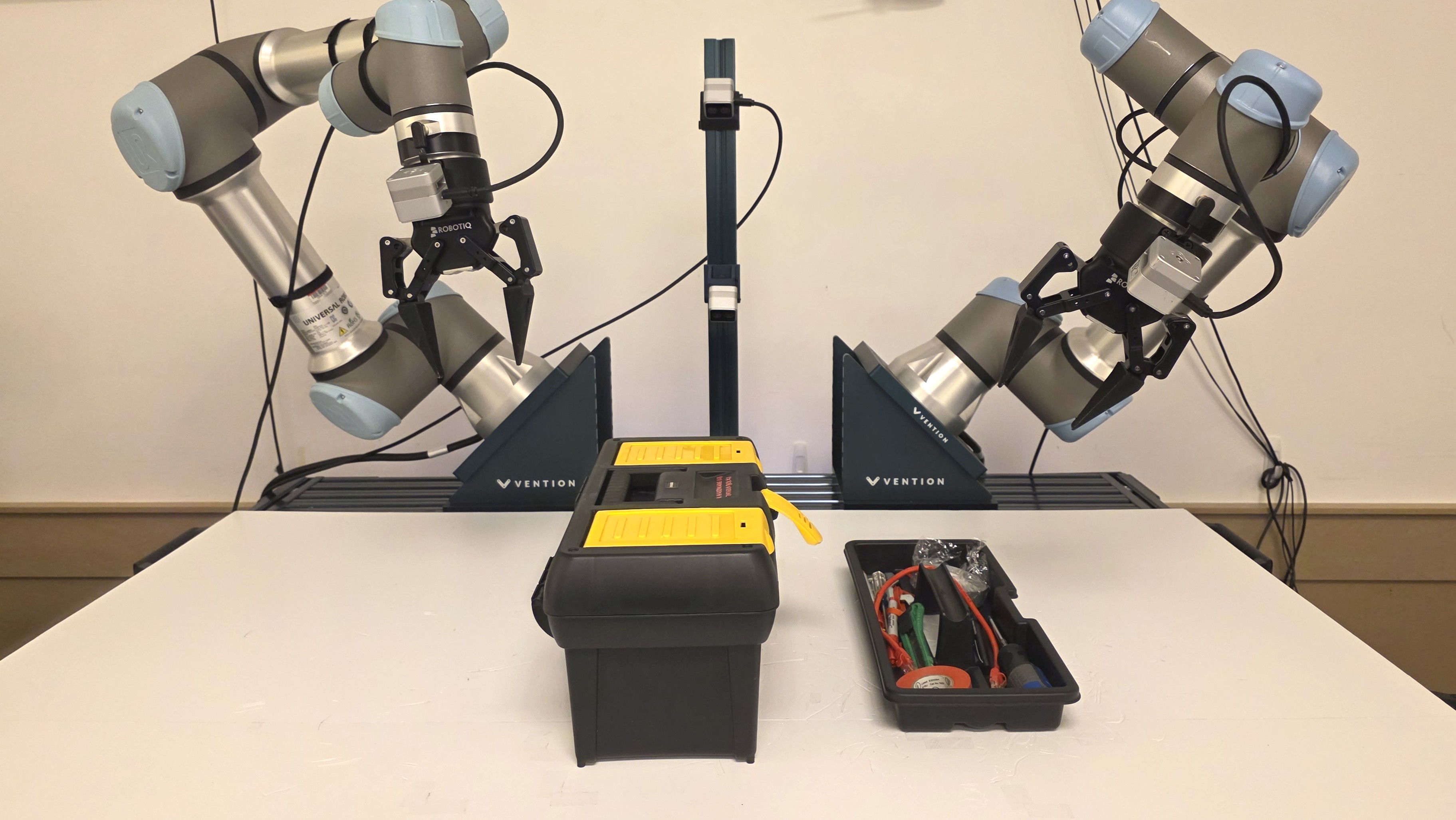
The September 29, 2026 Rho report described online adaptation through a lightweight latent policy while keeping its flow-matching action expert frozen. The researchers reported useful adaptation from as few as 15 corrected episodes in the studied setting. This is a specific research result about corrective feedback, not proof that a deployed robot can safely learn any behavior from a handful of interventions. Rho research paper.
A generalist robot model promises to reduce the amount of work needed to teach each new task. The practical benefit is a better starting point, not an exemption from understanding the destination. Every deployment still has particular objects, sensors, timing requirements, and failure costs. Autonomous behavior must be measured against those local conditions.
Octo, first submitted May 20, 2024, introduced an open generalist robot policy intended for adaptation to different observation and action spaces. Its experiments covered multiple robot platforms. Those results support the idea of reusable pretraining, while the authors' evaluated platforms remain distinct from a new customer's workcell. Octo paper.
Adaptation has several costs
In our analysis, adaptation should be measured in more than training time. Count demonstration collection, interface work, failed experiments, and the time required to establish reliable performance. A model that fine-tunes quickly can still demand considerable engineering around it. These surrounding costs matter when deciding whether a generalist approach is economical for a narrow job.
OpenVLA, submitted June 13, 2024, explored an open vision-language-action model and methods for fine-tuning it to new settings. It offers another approach to reusing broad robot experience. Its reported comparisons apply to the tasks and configurations used in the paper. OpenVLA paper.
Keep a local baseline
We would retain a simple task-specific policy or conventional controller as a benchmark. Compare accepted outcomes, interventions, and setup effort under the same conditions. A generalist policy earns its place when transfer improves that full comparison. The long-term promise is less repeated engineering, but the immediate decision should rest on the quality and cost of work performed by the adapted system.
General capability meets a local exception
A generalist model can provide a useful starting point, but deployment exposes the particularities of a place: a slightly different container, a new arrangement, or a contact condition rarely represented in training. Corrective feedback is attractive because it can target the exact failure that matters to the user. The challenge is to make that correction useful beyond the one episode without changing unrelated behavior unpredictably.
Freezing part of the model is one way to constrain the update. It narrows what can change, but it does not make the outcome self-evident. The modified component still influences actions. The relevant evidence is the resulting behavior across both the corrected situation and the situations that previously worked.
A different generalization target
Physical Intelligence’s pi0.5 study focused on broad generalization through mixed training sources and demonstrations in new homes. That differs from an experiment that deliberately collects corrective episodes for a local task. Both may expand useful autonomy, but they answer different questions: what the model can already do in a new environment, and how efficiently it can improve after encountering that environment. Physical Intelligence pi0.5 paper.
The Octo and OpenVLA lineage
The earlier Octo and OpenVLA work below helped make reusable robot policies and adaptation concrete research artifacts. The continued importance of fine-tuning is not evidence that generalist robotics has failed. It is evidence that physical tasks contain details a broad model may not have mastered. A useful foundation can reduce the adaptation burden while leaving a substantial role for local evidence.
This suggests a more informative way to compare systems. Instead of asking only which checkpoint performs best before any adaptation, examine the trajectory of improvement: how many demonstrations are required, what expertise collection demands, how long training takes, and whether gains persist under variation. The cost of obtaining a working policy includes the entire process.
Correction is also an operational event
A human intervention changes the course of the physical task. It may occur when an object is already displaced or a tool is in contact. The record must distinguish the robot’s failed action from the human’s recovery and the intended target behavior. Otherwise the update can learn the wrong association from a superficially successful episode.
That is why post-deployment learning deserves a more precise vocabulary than “the robot gets smarter.” The model changes in a particular way using particular evidence. The new behavior then needs to be evaluated. An improvement in the corrected task does not automatically establish improved performance elsewhere, and a limited research experiment does not establish a safe unattended update process.
Rho makes this discussion concrete by exposing the adaptive mechanism and a bounded experimental claim. The next useful evidence is how such updates behave over repeated corrections and a wider range of tasks. Adaptive autonomy will be valuable when improvement is both efficient and legible—when operators can tell what changed, why it changed, and what remains unproven.
The research context
Octo’s May 2024 paper presented a generalist policy trained on 800,000 trajectories and designed for adaptation to new observation and action spaces. The result helps place correction-based methods in context: a foundation model is valuable partly because of what it makes easier to learn afterward. But different adaptation procedures consume different kinds of effort. Offline demonstrations, online corrections, and hardware calibration are not interchangeable units. A comparison that counts only training episodes can miss the operator expertise or interruption required to obtain them. The practical evaluation should include how the data was collected, what the model already knew, and what behavior changed after the update. Original research source.
Sources & evidence
This archive preserves its original editorial date. Sources describe the events and announcements discussed; they do not establish today’s status.