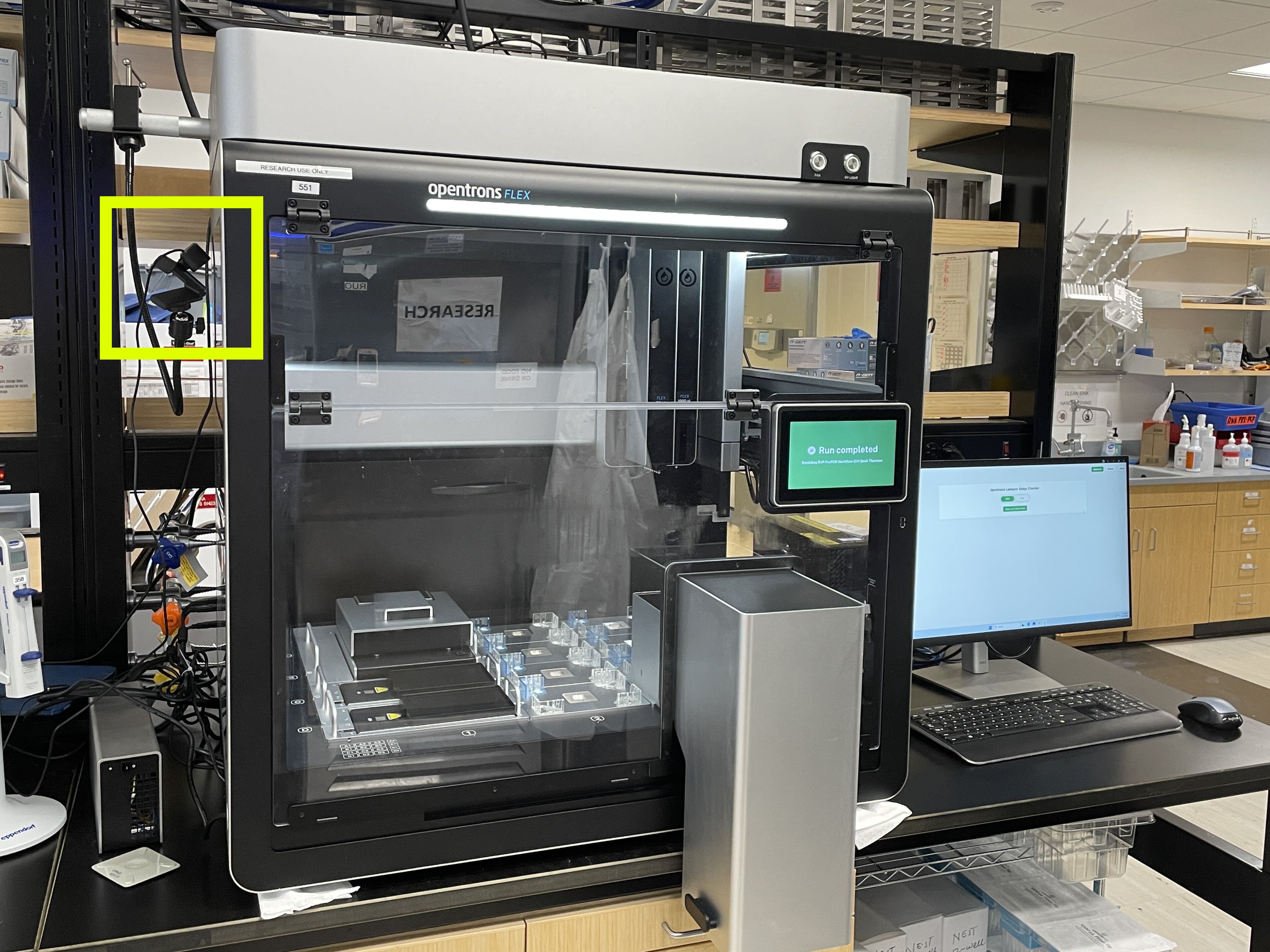
A laboratory robot can execute the correct digital protocol on the wrong physical setup. A misplaced plate or missing tip rack is a deployment problem at the interface between an operator’s preparation and a machine’s instructions.
UCLA researchers describe a passive Labware Setup Checker in an October 2 preprint. A consumer webcam observes an Opentrons Flex deck, and independent software compares detected labware with a reference protocol. It requires no change to the robot’s hardware or firmware. Primary study.
Verification is not an interlock
The checker reports missing, misplaced or unexpected labware. It does not interrupt or gate a run. That distinction matters: someone must review its result and decide whether the setup is ready.
The authors report a median verification time of 2.10 seconds on a CPU-only laptop and 4.24 seconds from capture to returned result in their cloud deployment. Those are response-time measurements, not estimates of assay accuracy or avoided experimental failures. Tests vary camera position, lighting and partial occlusion within the studied setup. Methods and results.
A separate observer needs an operating procedure
The near-term benefit is an additional check before motion begins. Its independence can simplify installation, but it also creates a handoff: an alert must reach the operator before the experiment starts, and the reference protocol must remain current.
Broader adoption should test unfamiliar labware, shifted cameras and ambiguous scenes, including what happens when the checker cannot decide. A useful next outcome would be fewer setup errors under a documented review procedure. Fast visual classification alone does not establish that operational result.
Image reuse basis: CC BY 4.0.
Sources & evidence
Sources describe the announcements and evidence available when this analysis was published. Company claims are attributed; plans and trials are not treated as sustained operation.