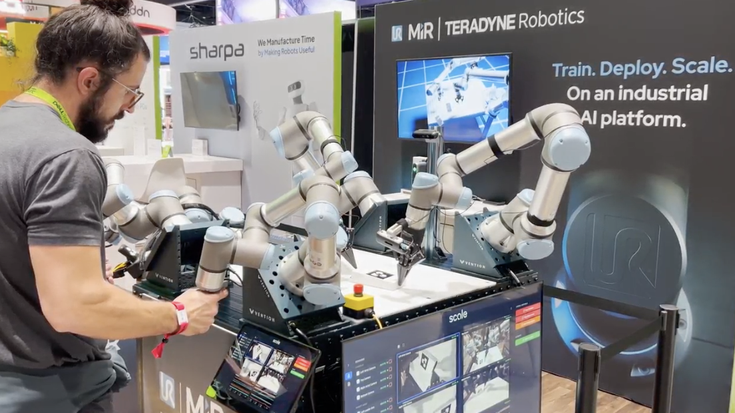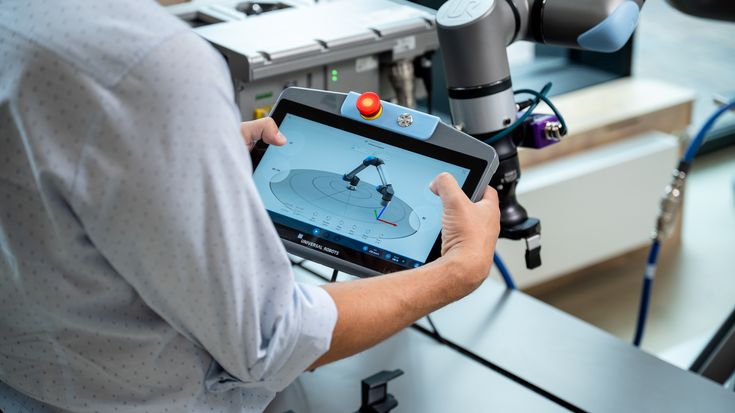
Universal Robots introduced Gen 7 at IMTS in Chicago on September 14, 2026. The platform combined new g-Series arms with a redesigned controller, teach pendant, and tool interface, anchored by PolyScope X. The launch matters because industrial autonomy must arrive through equipment that can be installed, programmed, and maintained—not only through a model demonstrated in a laboratory. Universal Robots Gen 7 launch.
A large installed base of industrial robots tells us that automation matters. It does not tell us how much judgment those machines exercise when conditions change. That distinction is central to the next phase of factory autonomy. The interesting question is which variations a robot can handle without a new program, fixture, or human intervention.
On September 24, 2026, the International Federation of Robotics reported that the worldwide operational stock of industrial robots reached five million in 2025. IFR also reported more than 600,000 installations during that year. These are industry-association statistics, not counts of generally autonomous machines. IFR World Robotics 2026 release.
Measure the variation handled
Our analysis would begin with the workcell. Can it accept a changed part orientation, detect an incorrect component, and recover from a failed pick? How much setup is required when the product changes? Those questions connect autonomy to an operating benefit. They also avoid treating every installed robot as evidence of the same capability.
RT-1, first submitted December 13, 2022, studied a transformer-based robot policy trained on varied tasks and examined generalization. It represents a research direction toward broader learned behavior. Its experimental results are separate from the industrial installation figures and should not be conflated with them. RT-1 paper.
Keep the metrics separate
We would report adoption, task flexibility, and sustained reliability as different measures. A factory can gain substantial value from a highly repeatable narrow system, while a flexible system may still require extensive validation. The next useful autonomy story will explain which operating constraint changed, how the change was measured, and what human support remains necessary over a full production shift.
An industry already full of robots
The IFR figures discussed below describe a large installed industrial base. They do not measure how many robots can generalize to unfamiliar tasks. That distinction changes the meaning of a new platform. A factory does not begin with an empty floor waiting for intelligence; it begins with processes, tooling, schedules, and machines that already work. A new robot must fit those conditions while offering enough additional capability to justify the disruption of introducing it.
The most consequential improvements may therefore be less theatrical than a novel motion. A clearer interface, a more direct sensor connection, or a reusable software component can reduce the distance between a successful trial and a supported application. Those are engineering gains, even when they do not resemble a leap in general intelligence.
ABB illustrates the parallel direction
ABB launched OmniCore EyeMotion on September 23, 2025, describing a vision system intended to work with third-party cameras and sensors on OmniCore-powered robots. Its release emphasized perception and adaptation integrated into an existing control platform. The comparison is architectural, not a head-to-head performance result: both companies are bringing additional perception into the machinery that customers already use to control industrial arms. ABB OmniCore EyeMotion launch.
What changes at the application boundary
An industrial application is more than the arm’s motion. Parts must arrive in a usable state, the gripper must match them, the camera must see the relevant features, and the completed operation must be checked. Learning can make some of these relationships more flexible, but it does not remove them. A robot that recognizes a part still needs a feasible grasp and enough clearance to execute it.
This makes the phrase AI-ready useful only when it is unpacked. It can describe access to sensing, computing, and software interfaces. It cannot, by itself, describe the reliability of an assembled cell on a particular product mix. The platform and the application make different claims. Confusing them makes a release look more complete than it is and hides the work still required of integrators.
The commercial contest is integration
The relevant competition is not simply whose robot can run the largest model. It is whose platform makes a useful application easier to commission, revise, and support. A system that allows an integrator to reuse a tested perception component may reduce engineering effort. A system that introduces a new dependency without clear diagnostics may increase it. Neither outcome can be read from the term physical AI alone.
This also explains why established robot suppliers remain important in the autonomy story. Their products are the point where software decisions become controlled physical movement. Interfaces that preserve predictable operation while accepting more flexible perception can create a path for learned behavior into factories. That path is necessarily narrower than a general claim of intelligence.
Gen 7 is therefore best read as an industrial platform release with implications for autonomy. Its significance is the connection it offers between new software and deployable machinery. Evidence of particular applications running across shifts, product changes, and maintenance cycles will determine how much of that potential becomes operational capability.
The research context
RT-1, published in December 2022, trained a transformer-based controller on varied real-world robot tasks. It is useful background for the current platform releases because it treats the control policy as something learned across experience rather than programmed as one fixed sequence. The industrial question is how that policy enters a complete application. A factory may need one narrow behavior performed extremely consistently, while a research benchmark rewards breadth across tasks. Neither objective is inherently more advanced; they impose different evidence requirements. Gen 7’s relevance is that it provides a place for those learned capabilities to meet established machinery. The next step is to demonstrate that the application retains the required consistency as parts, tooling, and operating conditions vary. Original research source.
Sources & evidence
This archive preserves its original editorial date. Sources describe the events and announcements discussed; they do not establish today’s status.