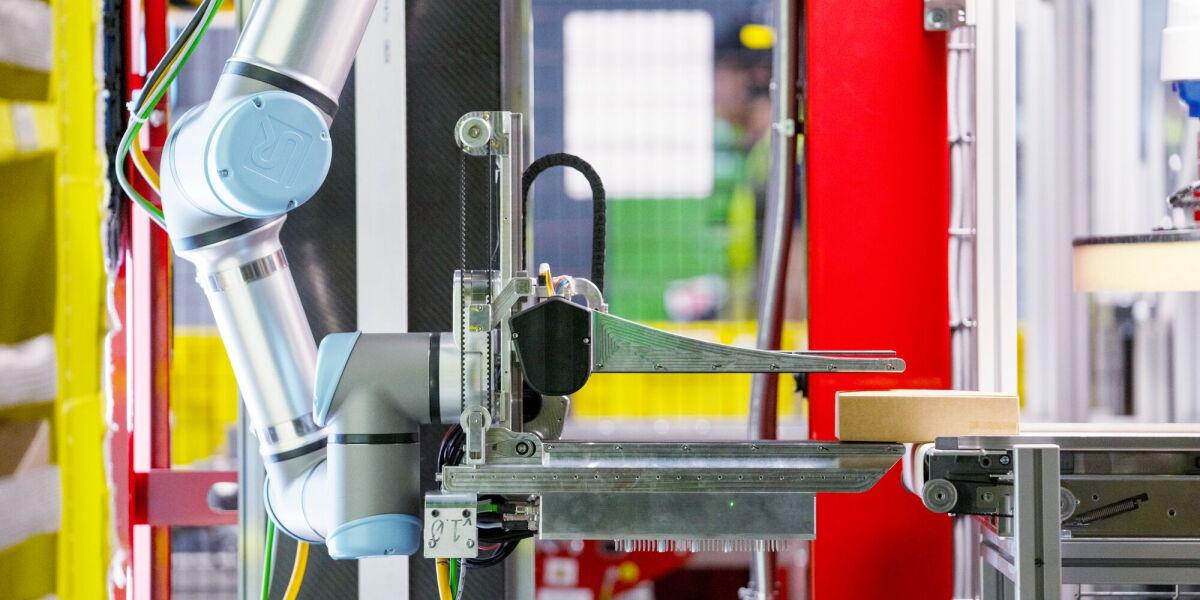
Amazon introduced Vulcan in Dortmund in 2025 as a robot that uses touch in picking and stowing. Its described mechanism combines force feedback with tooling that can move neighboring items and insert another object into a crowded compartment. The company claimed coverage of roughly 75% of its item types. That leaves a substantial boundary around the system’s capability. Amazon Vulcan announcement.
A robot that selects a grasp and then commits blindly has little opportunity to respond when the object moves. Autonomous manipulation needs a way to use fresh observations during the attempt. The important shift is from executing a chosen motion to managing a changing interaction, with success judged by the object and task afterward.
QT-Opt, submitted June 27, 2018, studied closed-loop visual grasping with reinforcement learning. The researchers described behaviors such as adjusting grasps and responding to disturbances in their evaluated setup. These are research findings about a particular system, not evidence that all learned grippers have the same resilience. QT-Opt paper.
Observe after contact
Our recommendation is to define the observations needed at each uncertain transition. Did the fingers make contact? Did the object lift? Is its pose still suitable for placement? A hypothetical packaging robot should not infer a secure grasp solely from having issued a close command. The outcome needs to be observed through appropriate sensing.
Diffusion Policy, first submitted March 7, 2023, represented robot behavior with a diffusion-based action policy and incorporated receding-horizon control. It provides another research approach to generating actions while repeatedly updating the plan from current observations. The published improvements apply to its benchmarked tasks. Diffusion Policy paper.
Make recovery part of success
We would include slipped objects, partial picks, and disturbed scenes in manipulation tests. A successful recovery should be distinguished from an unnoticed error that moves downstream. The value of feedback is not that every attempt becomes perfect. It is that the robot can recognize an imperfect attempt early enough to choose a better action or request help before the process becomes harder to repair.
Contact changes the information problem
A camera can show the outline of a package without revealing whether it is wedged against another item. The first small movement can provide information that the image lacks. Force feedback makes that interaction observable. It can help distinguish a free object from one that is resisting motion, although the interpretation still depends on the tool and task.
This is why touch matters to autonomy. The robot is no longer only selecting a trajectory from a static image. It can receive evidence during the action and adjust. The difficult part is connecting the observed force to the right response. Resistance might mean poor alignment, a trapped package, or an incorrect grasp. Simply measuring it does not automatically resolve the cause.
Industrial training is adding the same kind of evidence
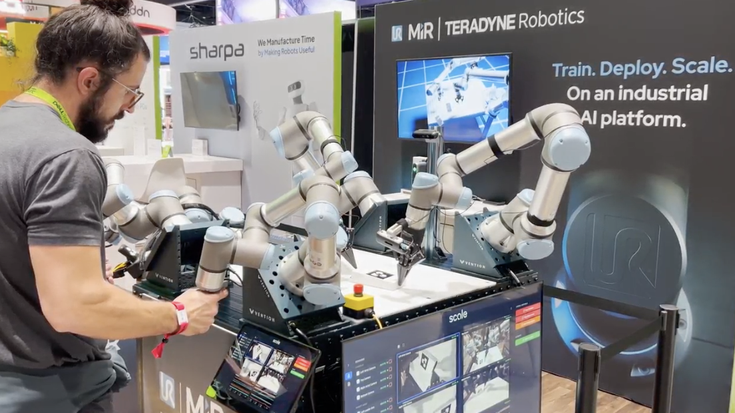
Universal Robots and Scale AI’s March 16, 2026 AI Trainer announcement described recording synchronized force, motion, and visual data through human-guided demonstrations. The emphasis was on collecting physical interaction, not merely video of a successful outcome. Universal Robots and Scale AI launch AI Trainer.
A successful grasp is not a successful fulfillment task
The QT-Opt and Diffusion Policy research below concerns learned control and grasping. Their results help explain why robotics research moved toward feedback-rich policies. A warehouse pick adds constraints beyond lifting an object: identify the correct item, avoid taking a neighbor with it, keep the packaging intact, and deliver it to the intended next location.
Each stage can invalidate the apparent success of the previous one. A secure grasp of the wrong product is still a fulfillment failure. An accurate selection that damages the package may create another exception. The evaluation therefore needs to follow the item, not stop at the moment it leaves the shelf. This is where operational data can reveal weaknesses that a short manipulation demonstration conceals.
Coverage is the commercially important limit
Amazon’s stated coverage should be read as a description of the intended item range, not a promise that three out of every four arbitrary grasps will succeed. Item type, arrangement, and task conditions are different dimensions. A system can be designed for an object category and still encounter a difficult configuration of that object.
The excluded cases matter economically because they determine how the human and automated workflows fit together. A robot that reliably handles a well-defined subset can be valuable if the remaining work is routed clearly. A robot with a broad but unpredictable failure boundary can impose more interruption. The goal is not to hide exceptions but to make them manageable.
Vulcan is a useful autonomy story because its physical mechanism is specific. It combines sensing and tooling to address contact inside crowded storage, rather than promising dexterity in the abstract. The next evidence of progress is the stability of that capability across item variation and repeated operation. Touch creates an additional source of information; dependable fulfillment depends on how the system uses it and how well it recognizes when it is insufficient.
The research context
QT-Opt’s June 2018 work studied scalable closed-loop grasping using a large collection of robot attempts. The closed loop matters: a policy can use observations as the action unfolds rather than commit completely to an initial plan. Vulcan’s tactile account adds a different observation channel to the same broad control problem. The comparison should not be treated as a direct benchmark contest, because the robots, objects, and tasks differ. It does show why manipulation capability cannot be summarized by recognition accuracy. The robot needs evidence about the changing physical interaction. A better initial prediction helps, but timely evidence during contact can determine whether the attempt completes safely and correctly. Original research source.
Sources & evidence
This archive preserves its original editorial date. Sources describe the events and announcements discussed; they do not establish today’s status.