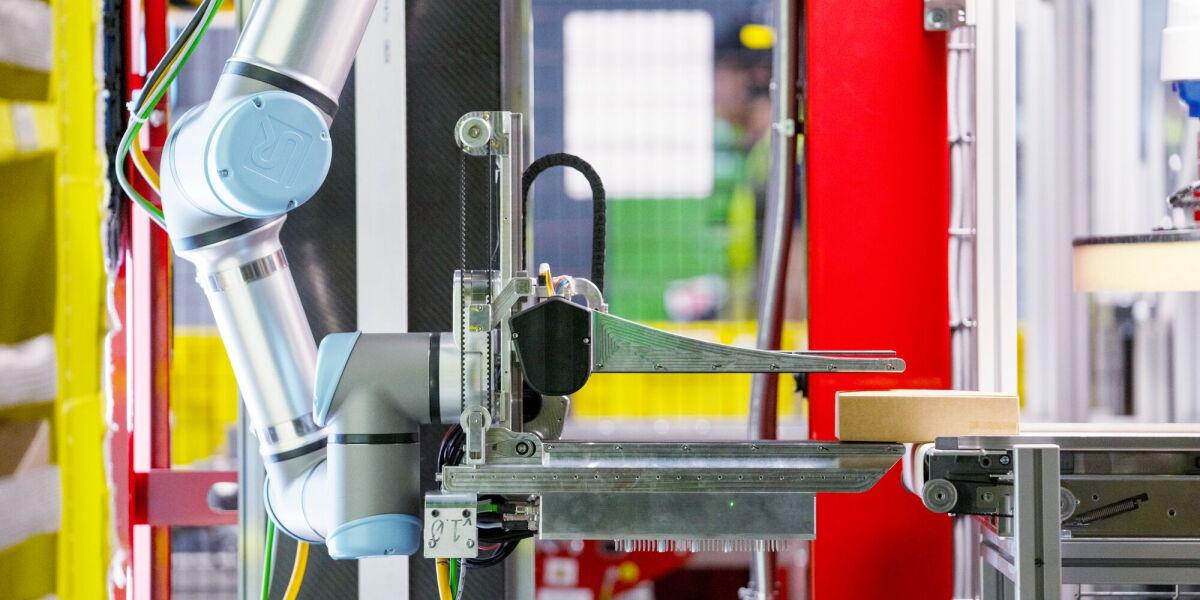
Amazon says Vulcan was trained with physical examples that included touch and force feedback, rather than simulation alone. Its published account describes learning which items it can handle and when to involve a person. That is a more useful account of manipulation learning than simply showing a robot imitate the visible path of a human hand. Amazon Vulcan announcement.
Showing a robot what to do is an appealing alternative to programming every motion. The demonstration, however, is not a complete instruction manual. A person's reach, grip, and viewpoint differ from the machine's. Autonomous imitation must preserve the purpose of the action while adapting the means, especially when the object or workspace also changes.
The one-shot imitation paper submitted February 5, 2018, studied learning robot behavior from human video after prior meta-learning across tasks. Its experiments included placement and pushing on robot arms. The prior learning is important: one demonstration did not mean the system began without relevant experience. One-Shot Imitation from Observing Humans.
Teach the invariant
Our interpretation is that demonstrations should clarify what must remain true. Is the goal to place an object at a particular location, align two surfaces, or maintain tension while moving? Those relationships may transfer better than a literal motion trace. A hypothetical worker teaching a folding operation should make the desired final arrangement observable.
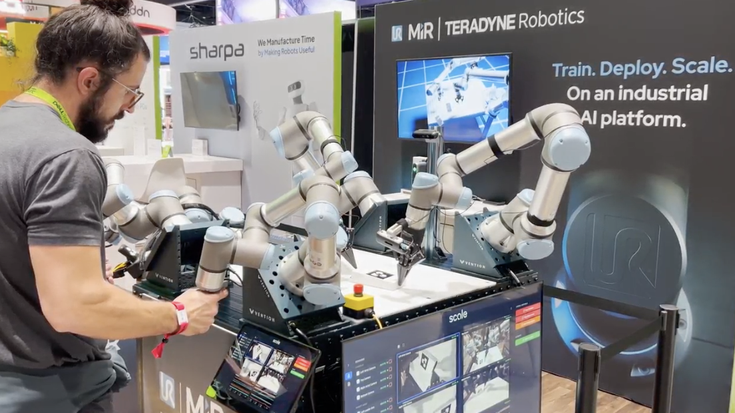
The April 23, 2023, bimanual-manipulation paper used a custom teleoperation interface to collect demonstrations and trained an action-sequence model. It offers a different route to teaching: collect actions through an interface suited to the robot rather than expect all correspondence to emerge from ordinary human video. Learning Fine-Grained Bimanual Manipulation.
Test beyond the recording
We would vary object placement and starting configuration during evaluation, while keeping the intended task unchanged. Include failures that require a small adjustment rather than a full restart. This reveals whether the learned behavior captures useful task structure. Demonstration-based autonomy earns its name when the robot can adapt the lesson, not merely reproduce the conditions under which the lesson was recorded.
The hidden decisions inside a demonstration
An experienced operator may pause, change grip, or reduce force in response to a subtle signal. A recording of the final motion can miss why the adjustment occurred. For a learning system, the relationship between observation and action is the valuable part. Without it, imitation risks becoming a fragile reproduction of the ideal sequence.
The problem is especially clear with deformable packaging or crowded storage. The same object can present different grasp surfaces and resistance depending on its arrangement. A useful demonstration should therefore expose the information available when a decision was made. If a recovery depends on touch, a purely visual record may be incomplete even when it shows the action clearly.
The industrial collection system is becoming explicit
The UR AI Trainer announcement described replayable demonstrations and synchronized capture on Scale AI’s stack. Universal Robots also announced an intention to release an industrial dataset later in 2026. That was a future commitment in the March release, not evidence that the promised dataset was already publicly available. Universal Robots and Scale AI launch AI Trainer.
One-shot learning and production learning differ
The one-shot imitation research discussed below asks whether a robot can infer a task from very limited demonstration. ACT examines a practical method for learning bimanual control from teleoperation. Both are important research directions, but the economics of a deployed application includes more than the number of examples used in a successful experiment.
Someone must define the task, collect representative failures, identify bad recordings, and decide whether the learned behavior is ready to run. A small nominal dataset can still require extensive expertise. Conversely, a larger collection can be economical if the capture system is reliable and reusable. Counting demonstrations alone therefore gives an incomplete picture of the effort required to obtain a dependable policy.
Recovery data changes the promise
A robot that sees only successful examples may have little basis for deciding what to do after a slip or an unexpected obstruction. Recovery examples can expose those states, but they also complicate the learning problem: the system must distinguish a deliberate correction from the normal path. The meaning of a pause or reversal depends on the state that caused it.
This is why a useful dataset is not simply the longest possible recording. It needs enough structure to connect actions to observations and outcomes. Clear task boundaries, synchronized signals, and labels for failure can make experience more interpretable. These properties are less visible than a polished robot video but more relevant to repeated operation.
Amazon’s account and the industrial training releases point toward the same issue: physical autonomy requires experience of the world pushing back. The strongest learning pipeline will preserve that feedback, including the moments when the robot or operator changed course. A successful imitation is valuable; a policy that recognizes when imitation is no longer appropriate is more valuable still.
The research context
The February 2018 one-shot imitation study explored learning a task from a single human demonstration, including transfer across embodiments in its experiments. That research question is different from asking how many examples guarantee reliable operation in a warehouse. A demonstration can communicate the intended task while leaving the robot to resolve the details of execution. Industrial learning therefore needs to distinguish task specification from control evidence. Showing what success looks like may be easy; supplying enough information about contact, variation, and failure may be harder. The two should not be combined into one impressive-sounding demonstration count. A useful claim states what was learned from the example and what capability was already present beforehand. Original research source.
Sources & evidence
This archive preserves its original editorial date. Sources describe the events and announcements discussed; they do not establish today’s status.