A robot navigating a crowd must avoid two unhelpful extremes: moving through an uncertain gap and freezing whenever people are nearby. The decision depends on what the robot believes about future clearance, not simply where obstacles appear now.
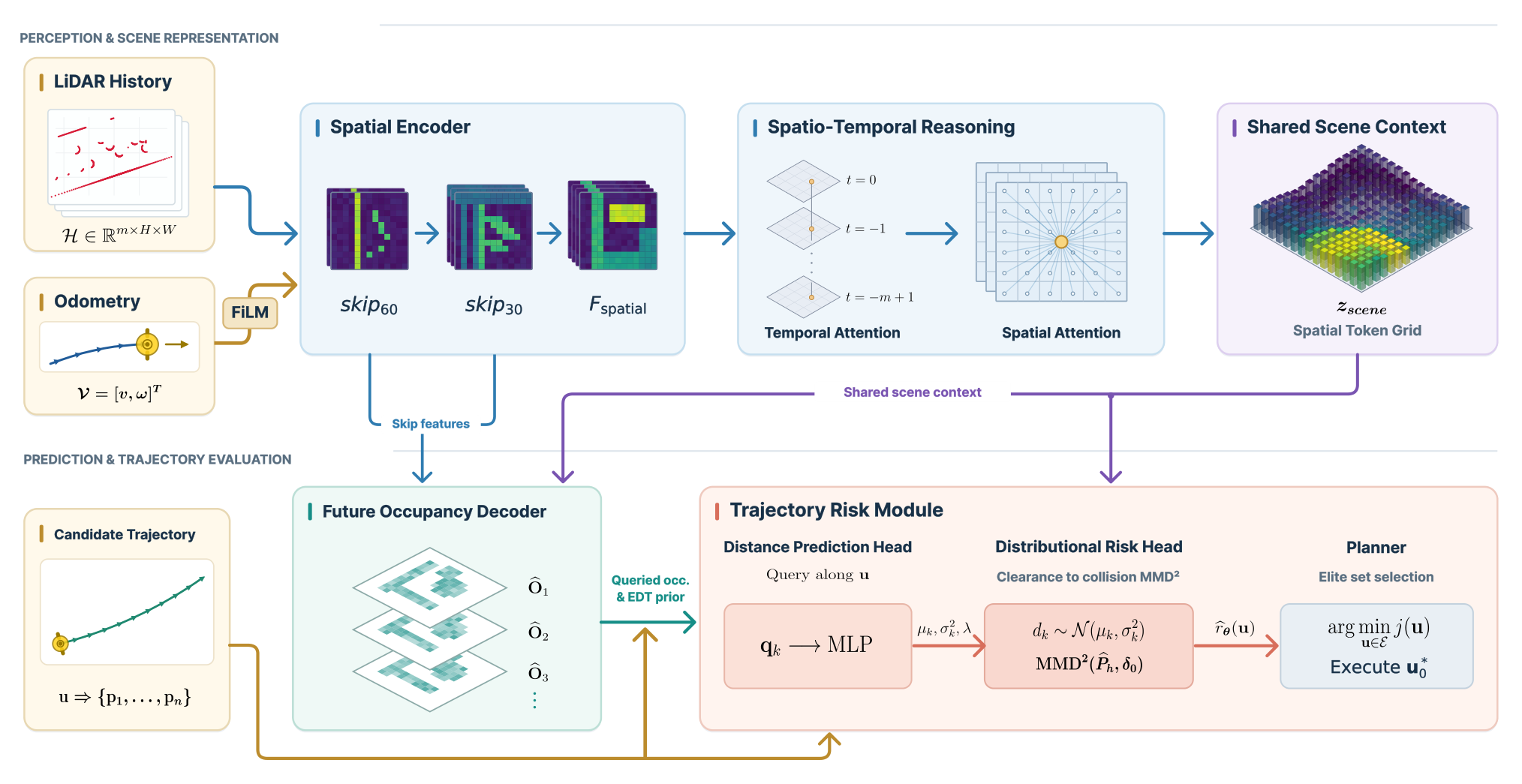
The October 29 DRIP preprint combines LiDAR occupancy forecasting with trajectory-conditioned risk estimation. For candidate movements, it predicts a distribution over the minimum separation from obstacles. Training connects this uncertainty to empirical collision outcomes. Primary source.
A prediction is not a safety certificate
The authors report closed-loop simulation comparisons with up to 45 pedestrians and physical demonstrations. The dense simulation result must not be described as an equally dense measured hardware deployment. Likewise, a learned risk estimate is not a formal guarantee that a path will remain safe. Primary source.
The representation has a useful purpose: distinguish a consistently wide route from a narrow route whose average prediction happens to look acceptable. But the planner evaluates a discrete set of motion primitives, which the paper identifies as a limit on maneuver flexibility.
The operating envelope determines the benefit
An operator would need results for the actual sensor position, pedestrian behavior and stopping constraints of the intended location. Missed detections and unusual movements can matter more than improvements in average simulated travel time.
The near-term research question is whether better-calibrated uncertainty reduces both collisions and unnecessary stops under matched conditions. Longer deployments should report interventions and failed forecasts as well as completed journeys. That would show when the risk estimate earns trust and when the system should yield or stop.
The source figure is reproduced unchanged under CC BY 4.0; attribution appears in the image caption.
Sources & evidence
Sources describe the announcements and evidence available when this analysis was published. Company claims are attributed; plans and trials are not treated as sustained operation.