A route can look gentle on a map yet be difficult for the controller that must drive it. Separating planning from execution can hide that mismatch until the vehicle reaches the terrain.
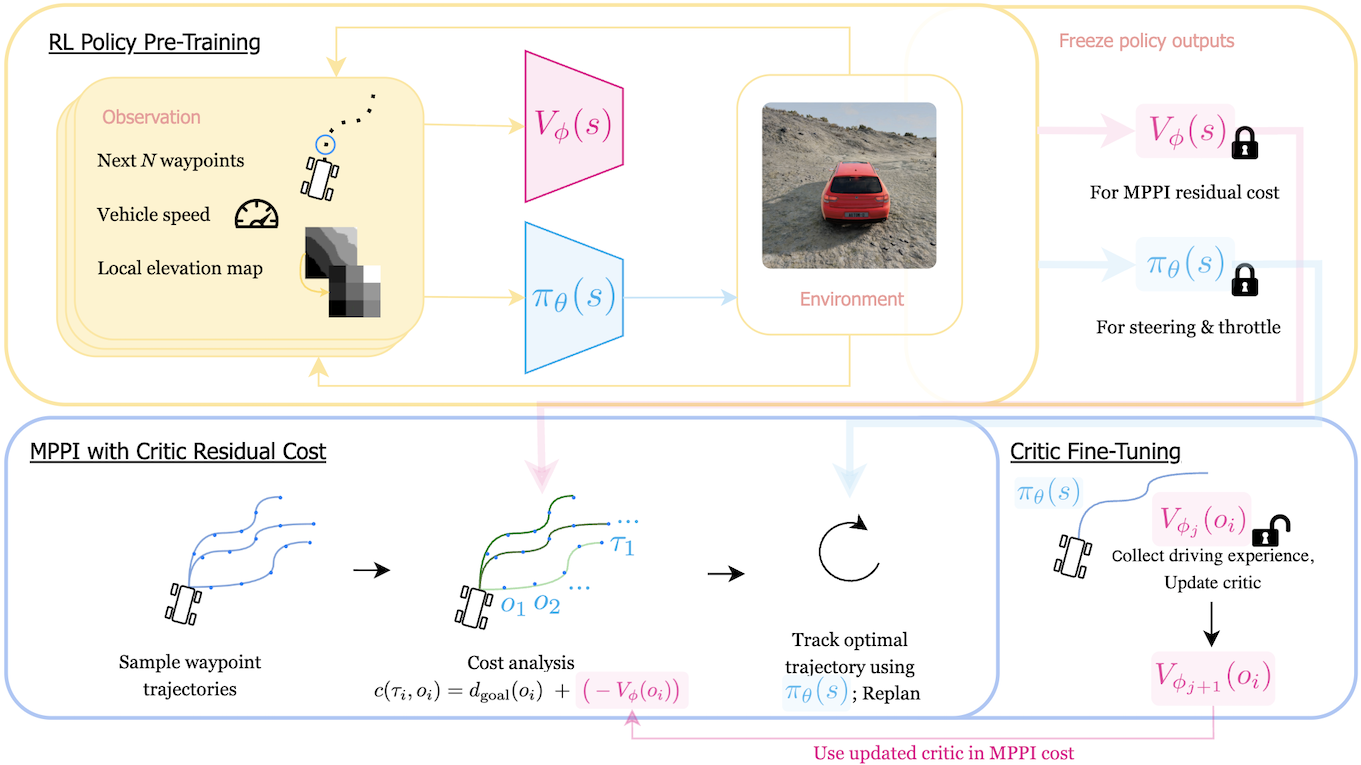
In an October 28 preprint, Carnegie Mellon researchers use the value function of a low-level reinforcement-learning controller to guide a higher-level route planner. That value estimates the controller’s prospects under a proposed state, so planning can account for more than a hand-designed terrain cost. Primary source.
Feedback changes the planning boundary
The hierarchy uses model predictive path integral planning and an online evaluation process to adapt the value estimate to unfamiliar driving experience. The authors evaluate it in a high-fidelity off-road simulator, comparing it with a baseline planner.
The physical boundary is explicit: vehicle validation is future work. The paper also identifies obstacle detection for densely cluttered environments as unfinished. Its results therefore support a simulation-based control argument, not a claim of autonomous field readiness. Primary source.
A learned cost must remain meaningful outside training
Using the controller’s own estimate can align route choice with achievable behavior. It can also create a common blind spot if both planner and controller are confident about terrain that differs from training.
The immediate next step is to test whether value estimates remain calibrated as surface and vehicle conditions change. Physical trials should compare disturbances, unsuccessful traversals and interventions under matched routes. If the feedback survives that test, it could help replace brittle planning heuristics with an execution-aware estimate; if it does not, an independent constraint or fallback remains essential.
The source figure is reproduced unchanged under CC BY 4.0; attribution appears in the image caption.
Sources & evidence
Sources describe the announcements and evidence available when this analysis was published. Company claims are attributed; plans and trials are not treated as sustained operation.