A slender robot that bends around an obstacle may need different stiffness when it begins supporting a load. Fixed hardware forces the designer to choose a compromise before the task starts.
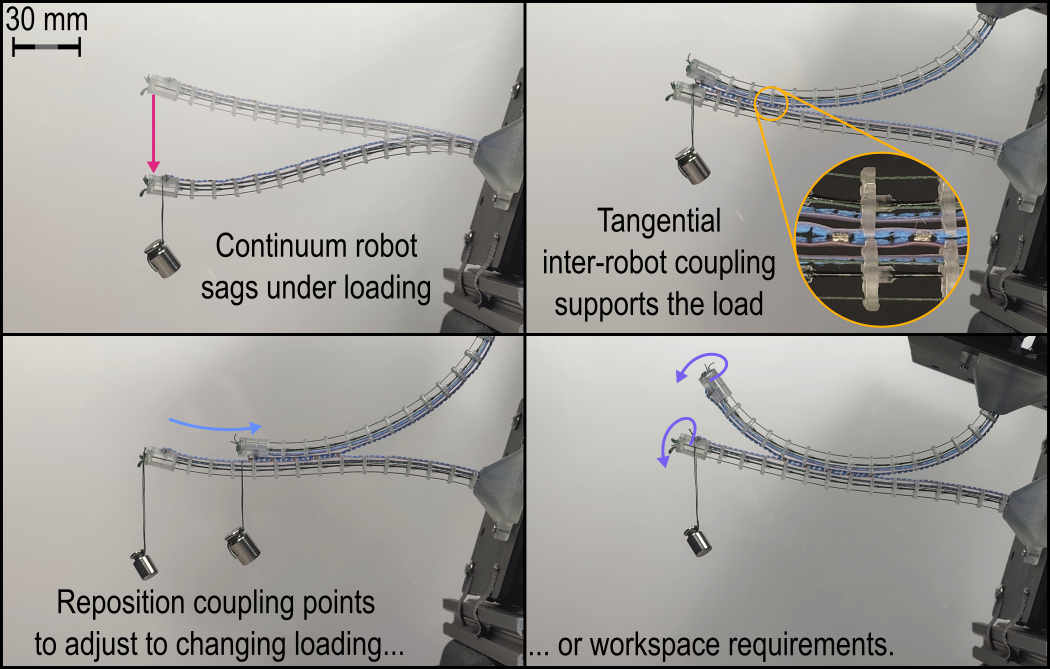
An October 29 preprint by Ella Walsh, Eric Diller and Jessica Burgner-Kahrs explores a different option: moving functional elements along a continuum robot’s body. Their prototype integrates conveyor-belt mechanisms into a nine-millimeter-diameter tendon-driven robot. Primary source.
The connection becomes an adjustable part
As a proof of concept, magnets on two belts create coupling points between robot bodies. Changing the position or number of connections changes their effective stiffness. The authors report a predictable inverse-cubic relationship between stiffness and coupling location in the tested arrangement. Primary source.
This is a mechanism study. It does not demonstrate an autonomous surgical procedure or a production manipulation system. The practical result is narrower and useful: an interaction that was previously fixed can be adjusted during operation.
Reconfiguration needs its own reliability budget
A movable coupling also adds failure modes. An application would need to establish positioning accuracy, wear, attachment reliability and the consequences of an unintended release. Those requirements may outweigh the benefit in a task where a fixed connection already works well.
The near-term opportunity is experimental: compare the same physical task with a fixed and an actively repositioned connection. If the mechanism reliably broadens the useful load or workspace envelope, it could reduce the need for separate robot designs. Repeated loaded cycles and task-level comparisons are the next evidence to watch.
The source figure is reproduced unchanged under CC BY 4.0; attribution appears in the image caption.
Sources & evidence
Sources describe the announcements and evidence available when this analysis was published. Company claims are attributed; plans and trials are not treated as sustained operation.