Two robot arms can each follow a plausible motion and still collide, arrive in the wrong order or pull against one another. Generating more demonstrations will not fix that problem if the generated data omits the coordination constraints.
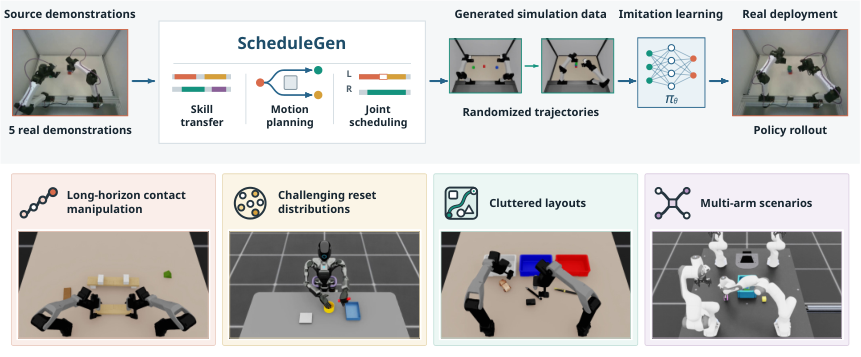
ScheduleGen, introduced in an October 29 preprint, combines motion adaptation with planning and scheduling for multi-arm demonstration generation. It preserves contact-oriented task segments while accounting for ordering, synchronization and collisions. The work concerns training-data generation and research evaluations, not a newly commissioned production cell. Primary source.
Generated data and executed work are different measures
Across 28 simulation task variants, the authors report 79.6 percent mean data-generation success and 65.5 percent mean policy success. Those figures answer different questions: whether a usable demonstration can be created, and whether a learned policy subsequently completes the task. Primary source.
Policies are also evaluated on eight physical variants, with reported success between 50 and 80 percent. The range is more informative than treating every arm or task as interchangeable. It shows both transfer and remaining failures. Primary source.
A workcell still needs its own acceptance test
For integrators, the immediate idea is to carry coordination requirements into the data pipeline instead of discovering every conflict after training. A cell’s tooling, object tolerances, controller timing and recovery procedure still define whether that data is useful.
If scheduled demonstrations reduce the effort of introducing another coordinated task, the approach could make multi-arm learning more practical. The next evidence should separate saved demonstration effort from commissioning effort and report how the system recovers when the planned handoff fails.
The source figure is reproduced unchanged under CC BY 4.0; attribution appears in the image caption.
Sources & evidence
Sources describe the announcements and evidence available when this analysis was published. Company claims are attributed; plans and trials are not treated as sustained operation.